Anonymous Model Ox Alpha Tops OpenRouter, Surpassing 4 Trillion Tokens in Total Usage.
The anonymous model Ox Alpha quickly rose to the top of OpenRouter’s rankings after its launch, setting a new record for daily model usage on the platform. Data shows that the top five applications alone have made more than 4 trillion Token calls to the model, while the developer’s identity remains undisclosed.
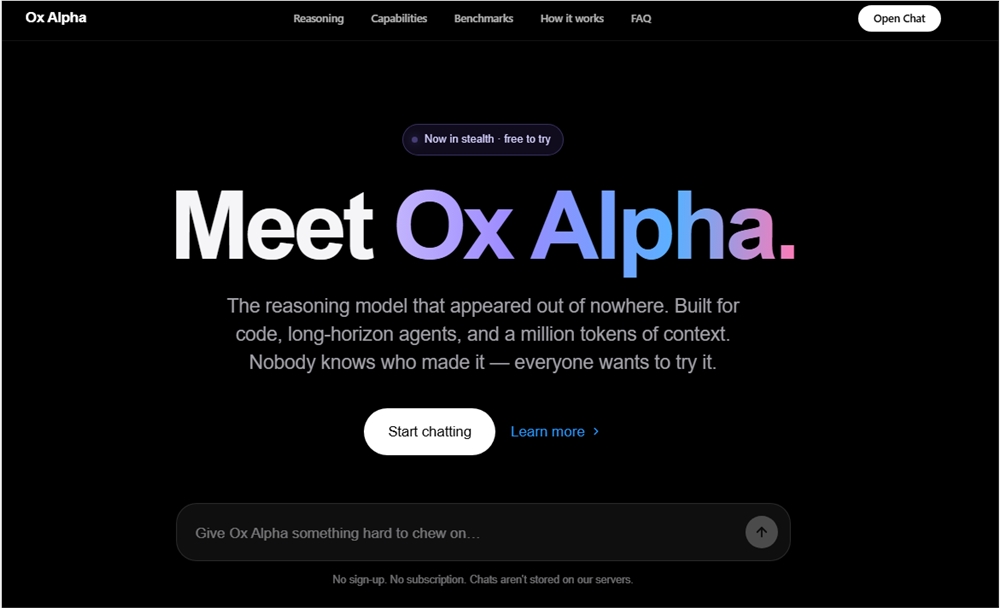
An anonymous AI model known as Ox Alpha—called “Niu Lai” in some Chinese tech circles—has quickly become one of the most talked-about models on OpenRouter. Shortly after being made available on the platform, its usage surged to the top of the rankings and even set a new record for single-day model consumption.
The speed of that rise has drawn unusual attention across the developer community. What initially looked like early experimentation by enthusiasts has rapidly turned into broad adoption in real-world environments, especially among developers building and running AI agents.
Usage climbed at an exceptional pace
According to the latest figures shared by OpenRouter, Ox Alpha has already exceeded 4 trillion tokens in cumulative usage from just the top five applications using it, including products such as Hermes Agent and Claude Code. That scale suggests the model is no longer confined to curiosity-driven testing. Instead, it has moved into active use across global developer workflows and agent-based tasks.
This kind of token volume is significant because it reflects sustained operational demand rather than isolated benchmarks or demo activity. In other words, Ox Alpha is being used where performance matters: in live systems, recurring automation, and coding-related work.
How OpenRouter is positioning the model
So far, the company behind Ox Alpha has not been publicly identified. OpenRouter describes the model as a reasoning-focused system designed for coding, long-running agent tasks, and production workflows. The platform has also made clear that the model is developed and operated by an anonymous third party.
That positioning is part of what has amplified market interest. OpenRouter is not presenting Ox Alpha as a general-purpose novelty model, but as one aimed directly at the kinds of use cases where enterprises and developers increasingly expect reliable, scalable performance.
Speculation around its origin continues
Because no developer has officially claimed Ox Alpha, discussion has shifted toward technical clues. Some observers have argued that certain model fingerprints—such as characteristics related to its tokenizer—appear highly similar to the GLM family from Zhipu, leading to speculation that it may be connected to that line of models.
At the same time, several researchers from Google DeepMind have posted comments on social media that some interpreted as hints of a relationship to a newer version of Gemini. Despite those theories, neither Google nor any other major AI company has formally acknowledged ownership of Ox Alpha.
For now, its identity remains unresolved, and that uncertainty has only intensified interest.
Why Ox Alpha is attracting so much attention
The fascination around Ox Alpha is not just about who built it. More importantly, it is about the scale of real usage it has already achieved. As AI agents move beyond evaluation and experimentation into software engineering, code execution, and other production scenarios, model adoption inside actual workflows has become an increasingly meaningful signal.
In that context, token volume is more than a vanity metric. It can indicate whether a model is trusted enough to be embedded in systems that perform ongoing tasks, generate code, or support business operations. Ox Alpha’s rapid expansion on OpenRouter therefore points to something larger than a temporary spike in attention: it suggests the model has already begun proving itself in practical environments.
That is why the market is watching so closely. An anonymous model reaching this level of usage—without a public developer identity, yet still becoming deeply integrated into agent and coding workflows—is unusual. Whether its origin is eventually revealed or not, Ox Alpha has already established itself as a major presence on OpenRouter and a noteworthy case in the evolving competition around AI models for real-world deployment.