DeepSeek Open-Sources Its First Agent Framework, Harness: “Everything Is a Plugin,” Giving AI a Modular Execution Engine
On August 13, DeepSeek released its first Agent product, the DeepSeek Harness v0.1 Developer Preview, and open-sourced it on GitHub under the MIT license. The framework is positioned as execution infrastructure beyond the model, emphasizing “Model + Harness = Agent.” Its plugin-based architecture helps developers quickly build agents capable of executing complex tasks.
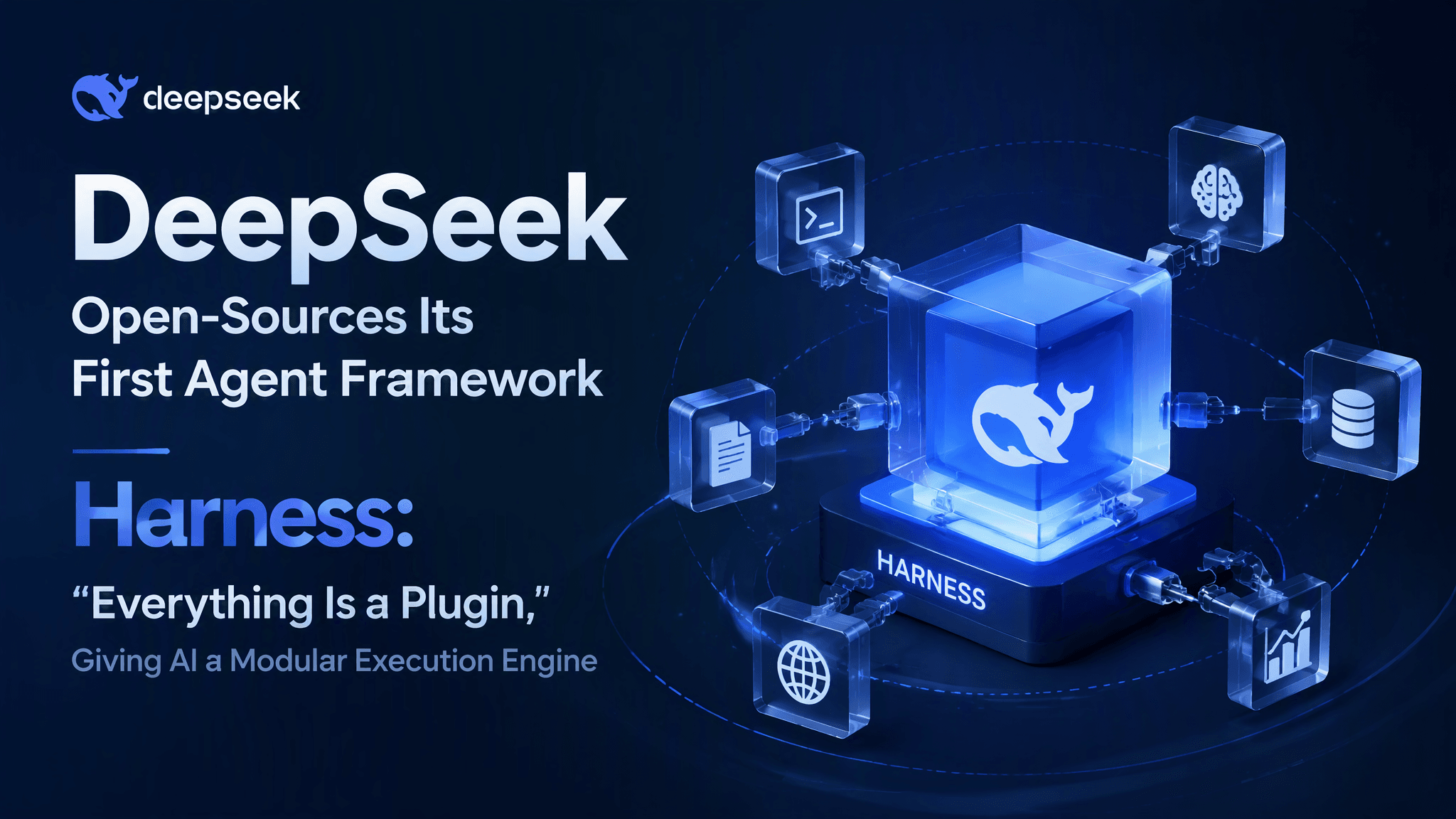
On the evening of August 13, DeepSeek introduced its first agent-focused product, DeepSeek Harness v0.1, releasing it as a developer preview and open-sourcing the project on GitHub under the MIT license. Rather than concentrating only on model performance, this new framework is aimed at a different layer of the AI stack: the infrastructure required to turn reasoning into real task execution.
DeepSeek summarizes the idea with a simple equation: Model + Harness = Agent. In this setup, the model handles thinking and inference, while Harness is responsible for carrying out actions in practice.
An execution layer for real-world AI agents
Harness is positioned as the operational foundation behind an intelligent agent. According to DeepSeek, it comes with the core capabilities needed for a local agent workspace, including project management, support for long-running collaborative tasks, multi-agent orchestration, context handling, online search, and access to external skills.
For developers, that means less time assembling separate components and more time working with a framework that is already designed to run complex agent workflows. Instead of building an execution environment from scratch, they can start from a more complete base.
Even in this early preview stage, DeepSeek is clearly emphasizing one central principle: everything is a plugin. That idea sits at the center of the product’s architecture and serves as the main answer to how the company believes agents should be built.
A modular architecture built around plugins
The most distinctive part of Harness is its open, plugin-driven design. A wide range of core capabilities—including models, tools, skills, sessions, sandboxes, storage, loops, scheduling systems, and UI components—can all be assembled as interchangeable plugins. In practice, this allows developers to swap out parts of the system and reorganize them as needed.
The framework is built on top of Cordis, a plugin meta-framework that handles lower-level responsibilities such as loading, unloading, and dependency management. On top of that foundation, Harness implements its business-facing components as standalone Cordis plugins.
These plugins work together through services and event-based mechanisms. One practical result is that developers can adjust how the system is composed at the configuration level, without having to directly modify source code for every change.
Four preset modes for different development needs
To support different usage scenarios, Harness includes four built-in operating modes. Each mode automatically loads a corresponding plugin set.
Standard mode: A full-featured setup intended for general development needs, with the complete toolset enabled.
PTC programmable tool-calling mode: Designed for workflows where the model generates code and coordinates multi-step tool chains.
Minimal mode: Keeps only Shell and file editing capabilities, making it suitable for lightweight environments and baseline testing.
Creative mode: Lets developers inspect runtime state, debug plugins in memory, and define entirely new operating modes.
Once a local Node.js toolchain is installed, developers can quickly launch a web-based interface through an npx command, lowering the barrier to trying the framework in a local environment.
Why this release matters
Harness v0.1 is still an early-stage release, but its direction is notable. The current agent ecosystem remains highly fragmented, with developers often forced to mix tools, orchestration layers, memory systems, execution environments, and interface modules from different sources. DeepSeek’s answer is to make the entire stack more decomposable and recombinable.
That approach arrives at a time when the broader industry is increasingly focused on plugin standards and ecosystem control. As players such as OpenAI push agent plugin frameworks and standards forward, DeepSeek has chosen a more open route by releasing its full foundation under the MIT license.
The significance of that move is twofold. First, it lowers the cost of building a custom agent system by giving developers a ready-made execution base. Second, it adds another infrastructure option to the open-source agent landscape, particularly for developers looking for a modular framework that treats execution not as an afterthought, but as the core of the agent itself.