Google DeepMind Unveils GenCeption: Advancing Computer Vision with Video Generation Models
Google DeepMind has unveiled GenCeption, a unified AI model that performs computer vision tasks such as depth estimation, image segmentation, and 3D pose estimation using pretrained video generation models. The model matches or outperforms specialized systems across multiple benchmarks while requiring far less training data, and also generalizes well to unseen subjects including multiple people, animals, and humanoid robots.
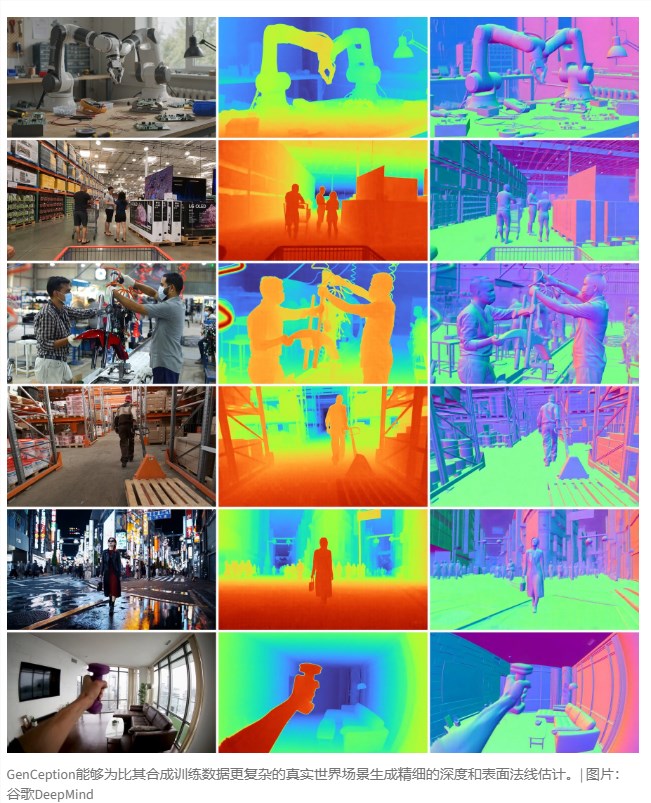
Google DeepMind has introduced a new model called GenCeption, presenting it as a different path toward general-purpose visual understanding. Rather than building a separate system for each classic computer vision task, the model is designed on top of a pretrained video generation backbone and can be adapted to handle jobs such as depth estimation, image segmentation, and 3D pose estimation. According to the research, it reaches performance close to—or in some cases beyond—current leading methods on multiple benchmarks, while relying on far less task-specific training data than traditional specialist models.
This release arrives at a time when most of computer vision is still dominated by highly targeted architectures. In practice, systems for segmentation, depth prediction, and other perception tasks are often developed independently, each optimized for a narrow objective. DeepMind’s argument is that large text-to-video models may already contain a broader form of visual knowledge. Because these models are trained to generate temporally coherent scenes, they implicitly learn about spatial structure, motion patterns, and the relationship between language and visual content. That, in turn, suggests they could evolve into a more universal visual foundation rather than remaining purely generative tools.
Built on a video generation model
GenCeption is based on Wan2.1, Alibaba’s open-source video model. DeepMind reworked the setup into a streamlined architecture that can produce task predictions in a single forward pass. Instead of maintaining separate pipelines for different outputs, the model uses text prompts to specify what kind of prediction should be generated from the same input video.
From one clip, GenCeption can produce multiple kinds of visual outputs, including:
depth maps
surface normals
segmentation masks
pose estimation results
The system also supports non-image outputs through trainable modules, including tasks such as 3D keypoint prediction.
Much lower data requirements
One of the most notable claims around GenCeption is its efficiency in training data. The model was trained mainly on a synthetic dataset of 7,500 videos. That dataset was created using 800 human models combined with 200 motion sequences, then rendered in Blender.
Even with this comparatively modest setup, DeepMind reports strong results across several tasks, including:
depth estimation
surface normal prediction
3D pose recognition
language-guided segmentation
What makes the result especially striking is the scale difference. The reported training data requirement is only about one-seventh to one-five-hundredth of what some existing models use.
Generalization beyond the training domain
Although the training material consists largely of synthetic single-person videos, GenCeption appears to generalize beyond that narrow source. DeepMind says the model can still handle a range of previously unseen scenarios in the real world, including multi-person scenes, animals, and even humanoid robots.
The research highlights that the model is able to generate visual predictions with meaningful structural detail even when the target category was not part of its original training distribution. That kind of transfer ability is important if video generation models are to be treated as a serious basis for broader visual understanding.
Current limitations
DeepMind also acknowledges that GenCeption is not without trade-offs. Jointly training one model across multiple tasks can reduce performance on some more difficult objectives, and inference speed remains an issue.
At the moment, processing a video of 81 frames takes roughly 6 to 10 seconds with the large model. That means the approach is promising, but still not optimized for many real-time or latency-sensitive applications.
A shift from generation to perception
GenCeption points to a broader trend: video generation models may be expanding from content creation systems into foundations for visual reasoning and scene understanding. If that direction continues, it could challenge the long-standing pattern in computer vision where each task is addressed by its own specialized model.
More broadly, the work raises an important research question for the next stage of AI: how to give generative models a more reliable grasp of physical structure and stronger feedback from the real world. DeepMind’s latest model does not solve that problem outright, but it does suggest that the line between “generation” and “understanding” is becoming increasingly blurred.