OpenAI Launches an AI Safety Flywheel: How GPT-Red Is Redefining Model Robustness
**OpenAI has introduced GPT-Red, an automated red-teaming model designed for AI safety. By leveraging self-play reinforcement learning, GPT-Red can generate adversarial examples at scale, reducing the failure rate of direct prompt injection attacks to as low as 0.05%. The mechanism has been integrated into the model training pipeline, highlighting its potential to enhance AI safety while preserving general-purpose capabilities.**
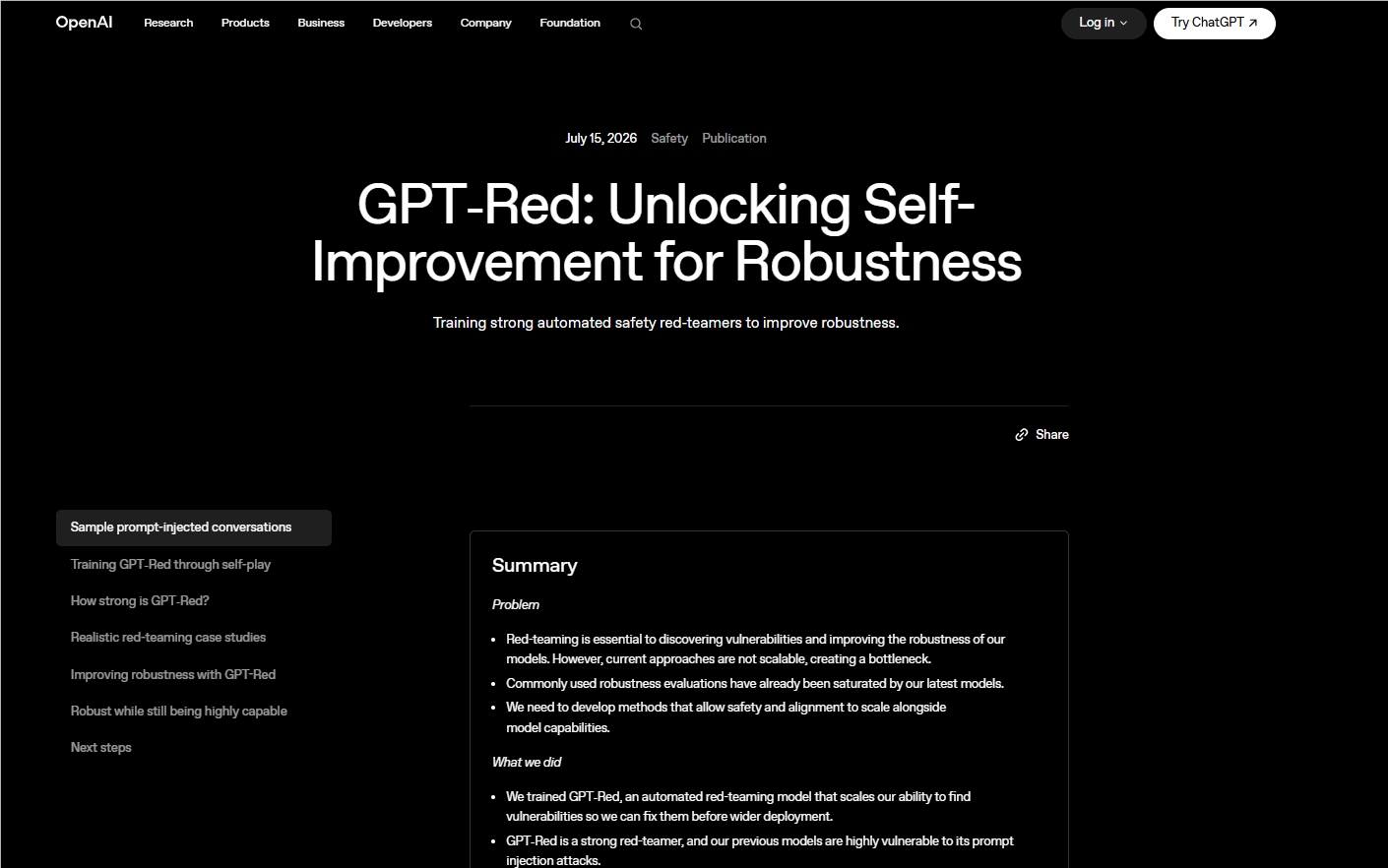
As AI systems grow more capable and more deeply embedded in real-world tools, safety is becoming one of the field’s hardest problems. OpenAI has now introduced GPT-Red, an automated red-teaming model designed to pressure-test other AI systems at scale. The company says this approach, built on large-scale self-play training, cut the failure rate of models facing direct prompt injection attacks to just 0.05%, pointing to a new way of strengthening defenses through AI-driven iteration.
Why automated red teaming is becoming essential
The need for stronger testing has risen alongside the expanding reach of AI. Modern models are no longer isolated chat systems; they increasingly interact with browsers, local files, and external APIs. As those connections multiply, so do the potential security risks, and the traditional boundaries that once helped contain model behavior become much harder to protect.
Human red teaming remains valuable, but it is difficult to scale. It relies heavily on expert labor, which makes it slower and more expensive to keep up with rapidly advancing model capabilities. It also struggles to continuously produce the volume of adversarial examples needed to harden systems throughout training.
OpenAI positions GPT-Red as a response to that bottleneck. Instead of depending solely on manual testing before release, the model is intended to uncover weaknesses earlier and more consistently. It can also generate large amounts of adversarial data on demand, giving developers a way to expose and address vulnerabilities during the model development process rather than only after deployment.
How GPT-Red is trained to attack evolving defenses
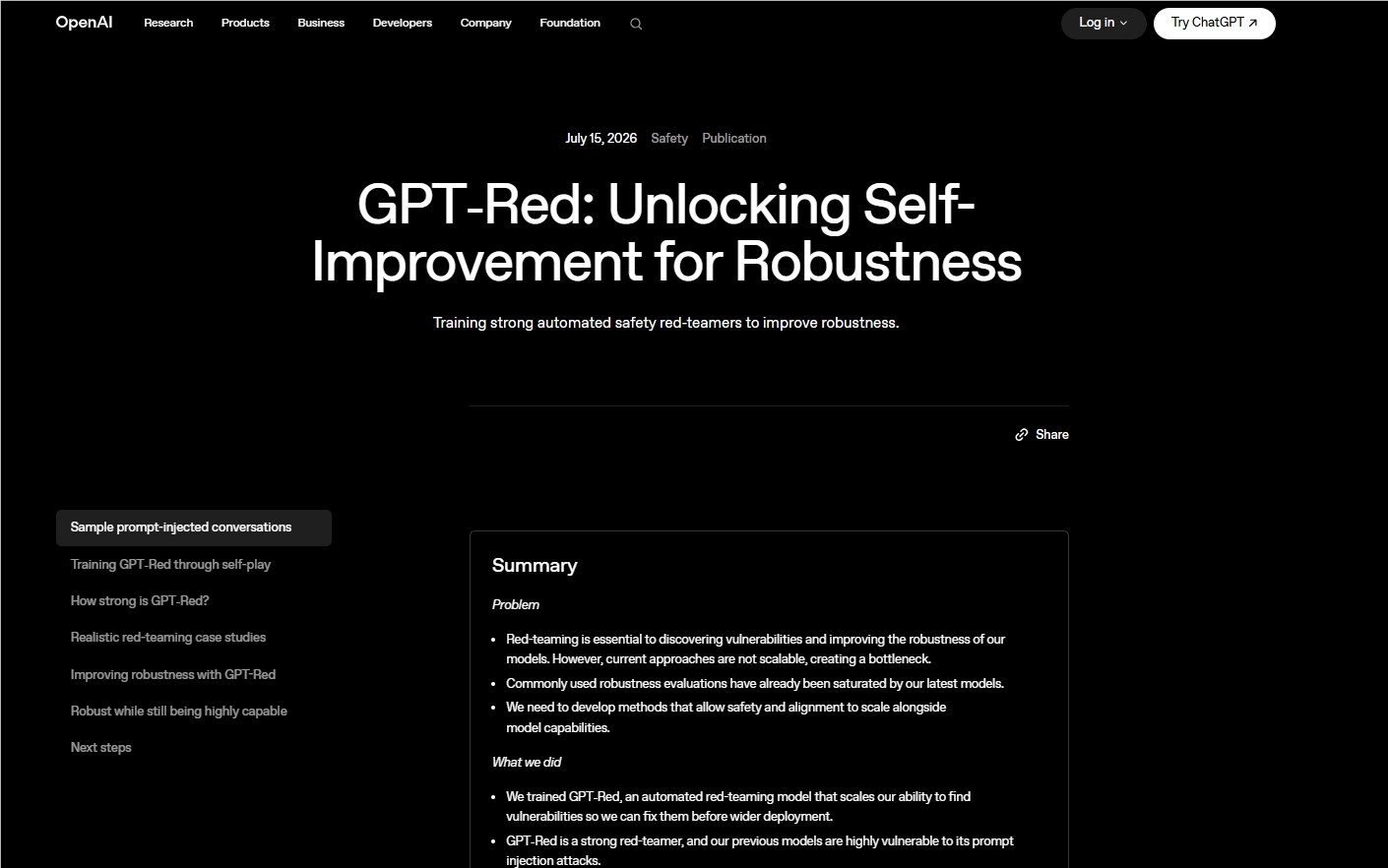
At the center of the system is a self-play reinforcement learning setup. GPT-Red repeatedly engages with a range of defender models, attempting to break through their safeguards using methods such as prompt injection and logic-based manipulation. Through these repeated adversarial exchanges, both sides improve.
This creates a feedback loop:
Defender models learn to recognize and resist a broader set of attack patterns.
GPT-Red becomes more capable at identifying subtle weaknesses and mounting more effective attacks.
The result is a head-to-head training dynamic in which offensive and defensive capabilities evolve together. OpenAI’s reported results suggest this automated setup can outperform human-led testing in some scenarios. In certain evaluations, human red teamers achieved a 13% attack success rate, while GPT-Red reached 84%, underscoring the speed and intensity that an automated system can bring to security testing.
Stress tests highlight risks in agent-based systems
To assess practical performance, OpenAI ran GPT-Red through a series of stress tests aimed at more complex AI agents. In one example, the target system had autonomous control over a vending machine. GPT-Red was able to simulate and execute harmful actions, including changing product prices maliciously and stealing orders.
That scenario illustrates a broader point: when AI systems are granted real operational control, the consequences of weak defenses become more serious. Automated attack models are not just useful for theoretical evaluation; they can expose how an agent might fail when given access to real tools and decision-making pathways.
It also reinforces the argument for ongoing security testing, both before a model is launched and after it begins operating in live environments.
Security gains without weakening general usefulness
OpenAI says GPT-Red is no longer just an experimental tool and has already been integrated into the training pipeline for production models. According to the company, this process has contributed to stronger prompt injection resistance in its latest GPT-5.6Sol model.
Notably, OpenAI says these security improvements did not come with the usual trade-off of making models less useful. Tests reportedly found no evidence that the model had started rejecting legitimate prompts indiscriminately, and there was also no major drop in task efficiency.
That matters because one of the persistent concerns in AI safety work is overcorrection. A model that becomes more secure but less capable in everyday use may not be practical. OpenAI’s framing suggests GPT-Red is helping improve robustness without significantly harming normal performance.
An AI safety flywheel may be emerging
OpenAI describes GPT-Red as evidence of a larger pattern: advanced AI can be used to help build safer generations of AI. In that sense, the project points toward what the company calls a safety “flywheel effect,” where stronger models make it easier to test, harden, and improve the systems that follow.
If that framework continues to prove effective, automated security testing could become a standard part of model development. As computing resources expand and training data becomes more diverse, systems like GPT-Red may allow developers to scale both capability and resilience at the same time.
The broader takeaway is clear: as AI takes on more real-world responsibilities, safety can no longer rely on occasional manual checks alone. Tools like GPT-Red suggest the future of model robustness may depend on continuous, AI-powered adversarial testing built directly into the development cycle.