New Google commercial imagines a Declaration of Independence written with help from AI
A new Google commercial imagines how the Founding Fathers might have collaborated on the Declaration of Independence using Google Workspace and Gemini. The tongue-in-cheek ad has drawn mostly positive reactions on YouTube and Instagram, while some Bluesky users criticized its AI angle as tone deaf.
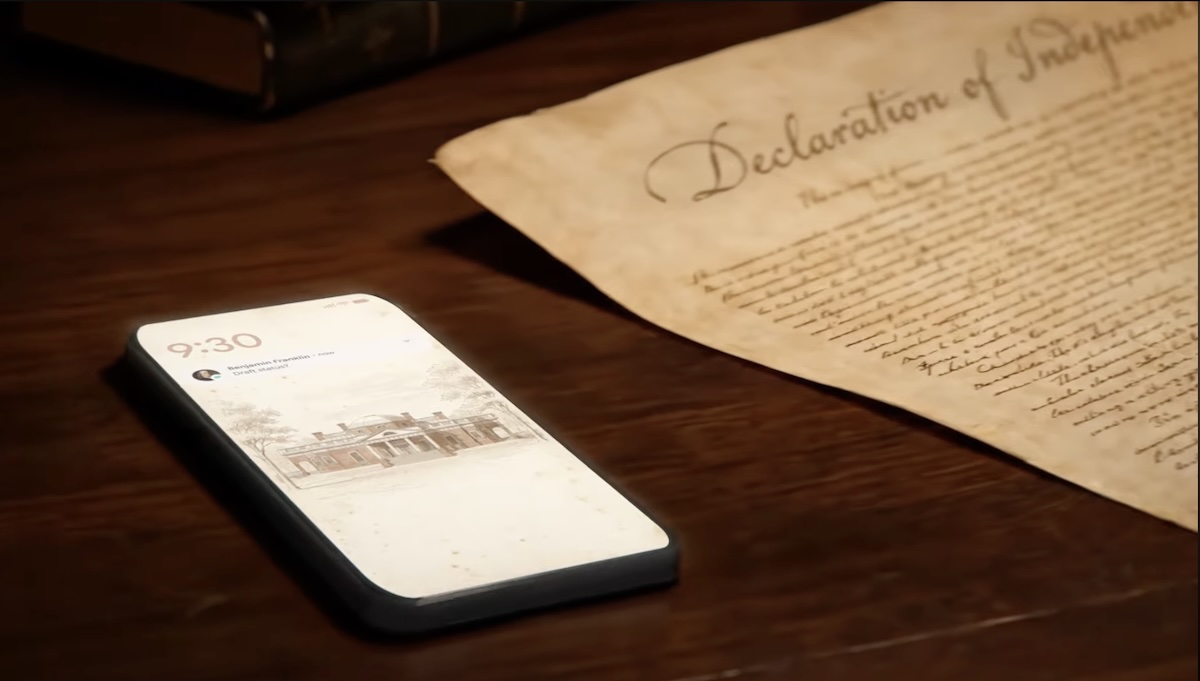
Marking 250 years since the Declaration of Independence was signed, Google has released a new ad that reimagines the American founding as if it unfolded inside Google Workspace.
The commercial plays the idea for laughs, posing a modern productivity question in an 18th-century setting: what would happen if the Founding Fathers had access to shared documents, messaging, video calls, and AI tools while drafting one of the most important texts in U.S. history?
Built around the line “Group project, but make it 1776,” the spot shows a mostly off-camera Thomas Jefferson working on a draft when a persistent message from Benjamin Franklin kicks off a highly stylized collaboration process. From there, the Declaration is treated less like a historic manuscript and more like a contemporary team document moving through a familiar office workflow.
Google Docs is used for suggested edits. A discussion is arranged through Google Calendar and then held remotely on Google Meet. The process eventually wraps with digital signatures, before the ad closes on a celebratory burst of fireworks.
How AI fits into the commercial
Because this is a major tech ad in 2026, artificial intelligence is woven into the concept as well. The founders are shown experimenting with Google’s “help me visualize” feature while trying out different animals for the national seal. Gemini appears as a meeting assistant, taking notes during the group call. The chatbot is also consulted when King George III requests access to the document, a request the group ultimately rejects.
The overall approach is intentionally playful rather than solemn. In one moment, Sam Adams breaks the rhythm with a joke: “Can we settle this over beers?” The ad leans into that kind of irreverent humor throughout, framing the Revolution-era figures as if they were modern coworkers trying to finish a shared assignment on deadline.
Measured AI messaging, but not no AI messaging
Compared with some recent campaigns from the tech industry, Google’s AI promotion here is relatively restrained. The commercial does not go so far as to suggest that AI would have improved the actual writing of the Declaration itself. That distinction matters, especially given criticism the company has faced before for ads that appeared to place too much creative or emotional labor in the hands of Gemini.
Still, AI remains a visible part of the pitch. In fact, one of the more striking AI-related elements may not be the fictional tools used by the founders, but the visual style of the ad itself. TechCrunch described the footage as having the strange sheen associated with AI-generated video, adding another layer to the conversation around how the commercial presents the technology.
Audience reaction has been split
Public response has not been uniform across platforms. Comments on YouTube and Instagram have seemed largely favorable, suggesting many viewers accepted the spot as a light historical parody and a clever way to showcase Google’s software ecosystem.
Reaction on Bluesky, however, has been much harsher. Critics there described the ad as “cringey” and “stunningly tone deaf,” with much of the backlash directed at the inclusion of AI in a story tied to a foundational political document.
At the same time, some observers argued that the ad’s AI component was more limited than the criticism implied. Historian Angus Johnston, for example, pointed out that it was notable “how little of this is actually AI.”
“Even in a corny fantasy joke, it’s impossible to make the case that AI is a useful tool for political organizing, writing, or human collaboration,” Johnston said.
That tension appears to define the commercial’s reception. For some viewers, it is a harmless and mildly amusing piece of brand theater. For others, it is another example of Silicon Valley trying to insert AI into places where it feels unnecessary, awkward, or historically absurd.
Either way, the ad succeeds in provoking exactly the kind of debate that increasingly follows any high-profile attempt to connect artificial intelligence with creativity, collaboration, or public life.