GPT-5.6 Scores 136 on an Offline IQ Assessment, Becoming the First AI Model to Break the 130 'Genius' Threshold
**The latest offline IQ benchmark from Tracking AI shows that multiple variants of OpenAI's GPT-5.6 achieved an IQ score of 136, marking the first time a large language model has surpassed the 130-point threshold. Beyond its benchmark performance, several developers report that GPT-5.6 also excels in real-world applications, including web development, building retrieval-augmented generation (RAG) ticketing systems, and software bug fixing.**
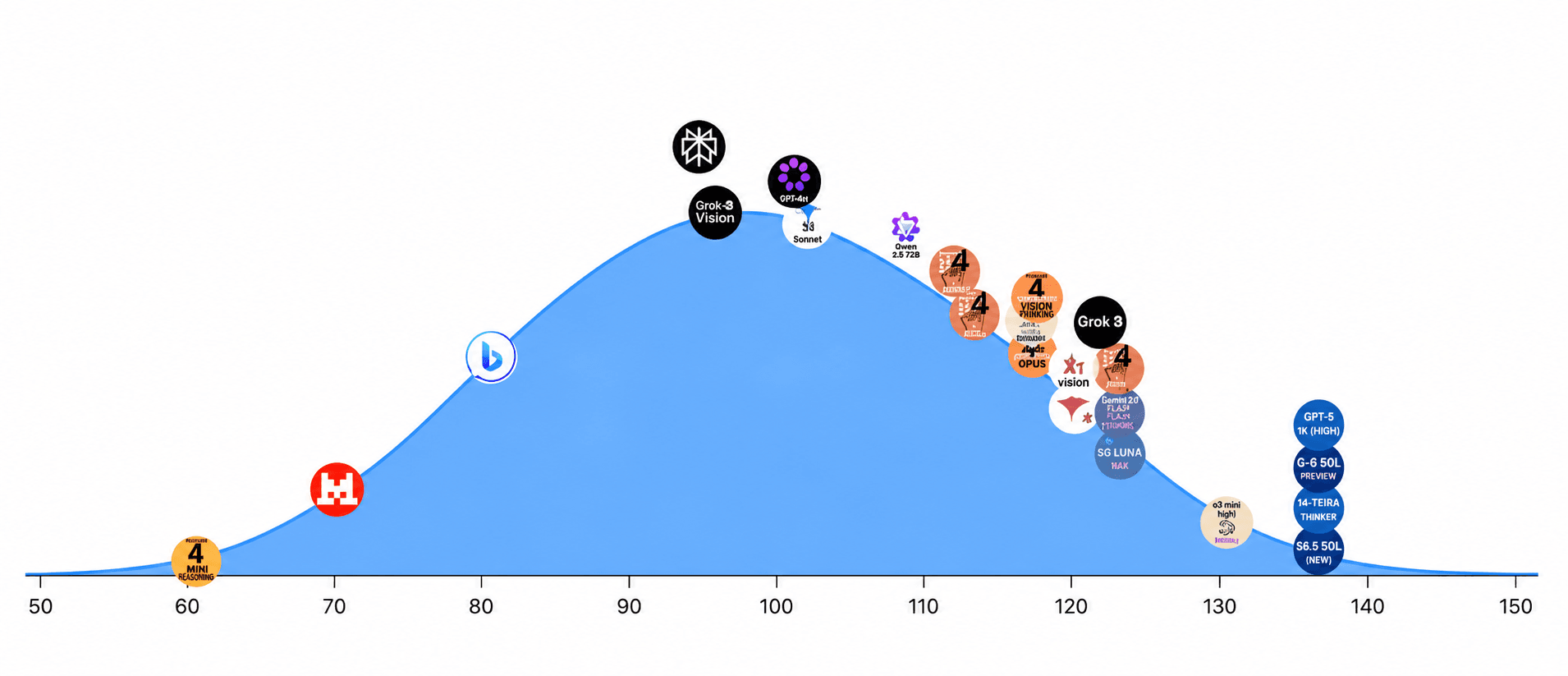
In Tracking AI’s latest offline IQ test, multiple versions of OpenAI GPT-5.6 scored 136 points, marking the first time a large language model has pushed its IQ result past the 130 threshold. In human IQ distributions, a score of 130 is typically seen as the starting point for “genius,” reached by only about 1% of people, which makes GPT-5.6’s result especially noteworthy.
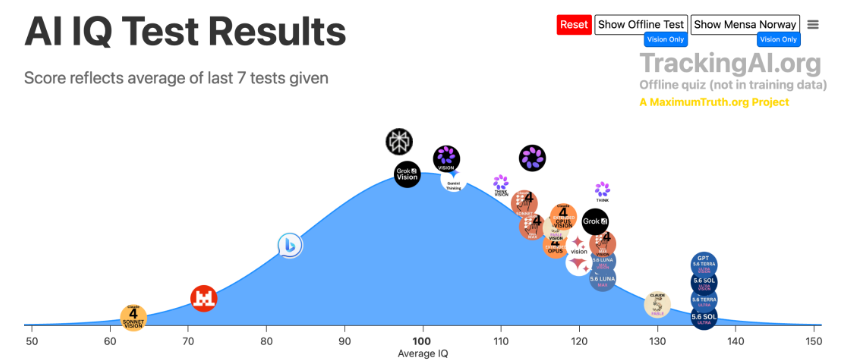
Leading rivals on a cheat-resistant offline question set
Tracking AI currently uses two test banks: one is a public Mensa Norway–style test, where models have previously scored above 140; the other is a non-public “offline question set,” mainly used to prevent models from gaining an advantage through prior exposure to the questions.
The breakthrough for GPT-5.6 came on this tougher offline set. The report says versions such as SOL and TERRA both reached 136, while the vision version kept pace as well. For comparison, Claude-5 Fable followed closely at 130, while GPT-5.6 LUNA Max and Claude-4.8 Opus scored between 117 and 123.
Over the past year, many products—from o3 to other flagship models—had come close to 130, but none had truly crossed it. GPT-5.6 became the first model to do so.
Not just good at tests—also impressive in real work
Beyond benchmark scores, hands-on feedback from developers has also been a key reason GPT-5.6 is drawing attention. Multiple developers say its performance on real production tasks is equally outstanding.
Web and physics simulation generation
Developer Amir Bohlooli tested Fable5 and GPT-5.6 Sol with the same physics simulation prompt. The results showed that GPT-5.6 chose a particle fluid simulation approach, advanced the physics process in real time, integrated the CSS, interface, and rendering into a single HTML file, and even auto-hosted it as a shareable webpage—delivering a finished product from a single sentence.
Building a RAG customer support ticketing system
Ramanpal Singh, meanwhile, used a single prompt to generate a RAG-based customer support ticketing system, including:
Four role configurations
An admin dashboard
Automatic complaint classification
Sentiment recognition capability
He said he built five applications in one go, at only a fraction of Fable5’s cost.
Bug-fixing experience
Claire Vo shared that she had been stuck on a bug and at one point even suspected the code itself was fundamentally broken. After switching to GPT-5.6 Sol, she gave it just one line—“I refuse to believe this can’t be fixed”—and the model solved it in one pass, even making it possible for other models to run the code correctly as well. In her view, Fable’s pursuit of absolute technical precision can become constraining, while Sol’s more pragmatic style is better at actually getting things done.
A high score that still calls for a measured view
One commenter said, “For 99% of people, this is already AGI.” But looking at the test itself, a score of 136 mainly measures standardized cognitive abilities such as abstract pattern recognition and logical reasoning. IQ tests cannot fully capture a model’s factual reliability, tool-use capability, or consistency in real professional scenarios.
Still, based on developers’ hands-on experience, GPT-5.6 appears to be steadily combining “being good at tests” with “being good at getting things done.” For large models, what matters more in the long run is whether they can remain stable when faced with entirely new problems they have never seen before—and for which there is nowhere to copy the answer from.