Ant open-sources LingBot-Video, an MoE video foundation model aimed at embodied AI
Ant’s LingBot team has released LingBot-Video, which it describes as the first open-source Mixture-of-Experts video foundation model built specifically for embodied intelligence. The model focuses on robotics-relevant video generation and world modeling, with reported gains in inference efficiency, physical plausibility, action understanding, and task completion, plus a leading score on the RBench benchmark.
Ant’s LingBot team has open-sourced LingBot-Video, a video foundation model designed for embodied AI and robotics rather than conventional text-to-video content creation. The release is notable because it reflects a broader shift in video model development: from generating visually impressive clips for media use toward models that can better represent actions, physical dynamics, and task execution in ways that may support robot training and world-model research.
According to the announcement, LingBot-Video uses a Mixture-of-Experts (MoE) architecture combined with a Diffusion Transformer design. Ant says the model has 30 billion total parameters but activates roughly 3 billion during generation, an approach intended to improve inference efficiency without giving up the benefits of a larger-capacity model. That matters in embodied AI, where real-time prediction and control loops place tighter latency constraints on models than creative video generation typically does.
The company positions LingBot-Video as a response to a core limitation of many current video generators: they can produce realistic-looking footage, but not necessarily videos that obey physical rules or preserve coherent action sequences in ways useful for robotics. For embodied systems, visual realism alone is not enough. Models must also capture object interaction, motion consistency, and whether a task is actually completed.
Benchmark performance on robotics-oriented evaluation
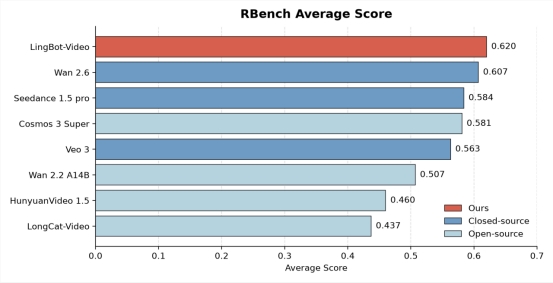
Ant cites results on RBench, a benchmark introduced by researchers from Peking University and ByteDance for evaluating robot-operation video generation. On that benchmark, LingBot-Video reportedly scored 0.620, ahead of Wan2.6 at 0.607, Seedance1.5Pro at 0.584, and Cosmos3Super at 0.581. If the result holds up under broader community scrutiny, it suggests the model may be stronger than general-purpose alternatives at generating robot-related video sequences that remain physically plausible and task-consistent.
The announcement also references internal evaluations across both general video quality and embodied scenarios, where LingBot-Video was said to outperform several open models including NVIDIA Cosmos3, Wan2.2A14B, LongCat-Video, Hunyuan Video 1.5, and LTX-2.3 in embodied-domain settings. As with all vendor-reported benchmarks, those claims will need independent reproduction to establish how robust the gains are across different tasks and datasets.
Training data and alignment choices
One of the more interesting aspects of the release is the training setup. Ant says it built a data profiling engine and trained on large-scale internet video along with robotics-relevant sources spanning VLA, VLN, and egocentric data. The company says the embodied portion totals 70,000 hours of data, covering dexterous manipulation, robot mobility, and first-person interaction scenarios. That combination is intended to help the model learn relationships between actions and environmental change, rather than only surface-level visual patterns.
On the optimization side, LingBot-Video reportedly uses a multi-dimensional reinforcement learning reward system. Beyond standard objectives such as aesthetics, prompt following, and motion consistency, Ant says the model is also aligned on physical plausibility and task completion. Those are exactly the criteria that could make a video model more useful as infrastructure for simulation, action prediction, or world models in robotics research.
Why this matters
The release is significant less because it is another video generator and more because it illustrates a maturing split in the market. One branch of video AI is optimized for entertainment, advertising, and creator workflows. The other is being shaped around machine perception, prediction, and interaction with the physical world. LingBot-Video clearly targets the second category.
If the open-source release includes enough weights, code, and evaluation details for outside researchers to build on, it could become useful in several areas: robot action forecasting, simulation data generation, action-conditioned modeling, and broader world-model research. The embodied AI field has been constrained by a lack of openly available models tuned for physically grounded video understanding and generation, so an open model in this category could attract attention from both academic labs and robotics startups.
At the same time, the larger question is whether specialized video models for robotics can become practical components in training and control stacks, rather than just research demos. That will depend on how well they generalize beyond benchmark tasks, how efficiently they run in real-world workflows, and whether they can reliably model causal interactions in complex environments.
For now, LingBot-Video stands out as a credible open-source attempt to push video foundation models toward embodied intelligence, an area that is increasingly central to the next phase of AI systems that must act, not just generate.