OpenAI Upgrades ChatGPT Memory with 'Dreaming V3', Slashes Compute Costs by 80%
OpenAI has deployed a major architectural overhaul to ChatGPT’s memory system, introducing the Dreaming V3 mechanism. The update directly addresses persistent issues with stale and inaccurate recollections, cuts compute requirements to one-fifth for free-tier usage, and expands memory capacity for paid subscribers while preparing for a broader public rollout.
OpenAI Overhauls ChatGPT Memory Architecture
OpenAI has announced a significant architectural upgrade to ChatGPT’s memory system, officially rolling out the new Dreaming V3 mechanism. The update is designed to resolve two of the most persistent user complaints: outdated information and inaccurate recall. Beyond improving reliability, the overhaul dramatically enhances the system’s scalability, positioning it to support hundreds of millions of users efficiently.
From Explicit Prompts to Autonomous Evolution
ChatGPT’s memory feature has undergone a clear evolutionary path since its initial launch in 2024. The original iteration relied entirely on explicit user commands, such as “remember this,” which forced the model to mechanically store limited background context. In 2025, OpenAI introduced the initial Dreaming framework, allowing the system to autonomously reference conversation history and filter relevant details in the background. With the release of Dreaming V3, this background processing has matured into the foundational architecture of the entire memory system.
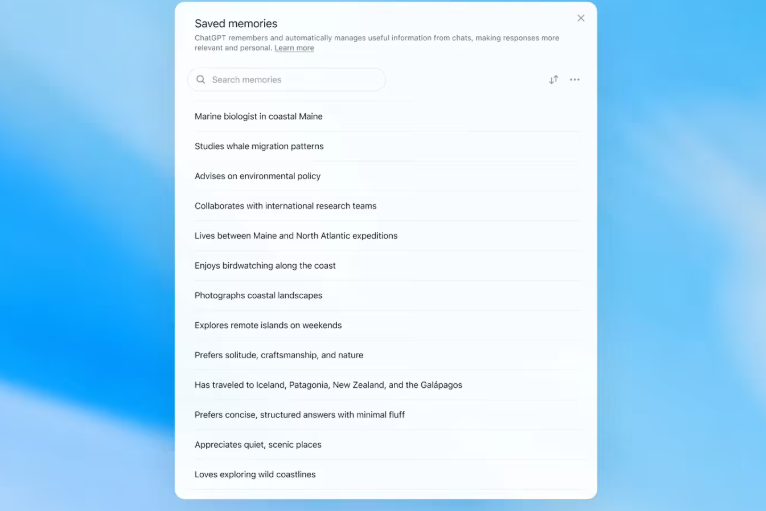
Under the new V3 framework, ChatGPT can now automatically update user profiles as time passes, ensuring that preferences and personal details remain current. The system consolidates important life details and behavioral patterns into structured summaries, which are displayed on a dedicated user dashboard. Users can directly view, edit, or supplement these entries, and even ask the model to trace the origin or specific context of any stored memory.
Compute Efficiency and Expanded Access
A major breakthrough accompanying the architectural shift is a drastic reduction in computational overhead. According to OpenAI, recent technical optimizations have reduced the compute resources required to run Dreaming V3 for free-tier users to just one-fifth of previous levels. This efficiency gain removes a critical bottleneck, allowing OpenAI to safely scale the advanced memory feature to its broader free user base without compromising service quality.
Currently, the upgraded memory system is available to Plus and Pro subscribers in the United States. Alongside the rollout, OpenAI has doubled the memory storage capacity for these paid tiers. The compute savings and improved accuracy metrics suggest that a wider public release is imminent, marking a significant step forward in making personalized, context-aware AI assistants both scalable and reliable.