Meta Unveils Its First AI Model, Muse Spark, with a $100-Billion Budget to Accelerate the Development of Superintelligence
Meta has officially launched its first in-house high-performance AI model, Muse Spark, which has already been integrated into the Meta AI service. This model employs a multi-agent collaboration mechanism, aiming to enhance complex reasoning and multimodal understanding capabilities—a key component of Meta’s AI investment plan totaling up to $100 billion.

Meta has officially unveiled its first in-house high-performance AI model, Muse Spark, marking a major milestone in Mark Zuckerberg’s “superintelligence” strategy backed by investments exceeding $100 billion. As the first achievement from the newly established Meta Superintelligence Labs, Muse Spark is positioned as a world-class intelligent assistant, signaling Meta’s accelerating push to catch up with competitors such as OpenAI and Anthropic.
Led by Scale AI Founder, Now Integrated into Meta AI
According to Meta CEO Mark Zuckerberg, Muse Spark was led by Alexandr Wang, founder of Scale AI, and has already been integrated into the Meta AI ecosystem to support users across its platforms.
Technically, Muse Spark adopts a multi-agent collaborative architecture, enabling it to handle complex, long-chain tasks simultaneously—such as comprehensive travel planning and destination comparisons. The model also demonstrates strong visual understanding capabilities, analyzing images in real time and delivering in-depth insights, highlighting its advanced multimodal processing strengths.
Not Open Source for Now, With Plans to Gradually Reopen
At present, Muse Spark has not been open-sourced. However, Meta has indicated that future versions may gradually return to an open-source approach. This strategic shift comes amid the company’s continued escalation of massive AI investments.
According to figures disclosed by Meta:
AI-related spending in 2026 is projected to reach $115 billion to $135 billion;
AI spending in 2025 totaled $72.2 billion;
The company’s overall revenue grew 22% year-over-year in 2025.
These figures suggest that heavy R&D investment is already translating into financial returns, while also providing strong capital backing for Meta’s long-term AI ambitions.
Competing with GPT Pro and Gemini Deep Think
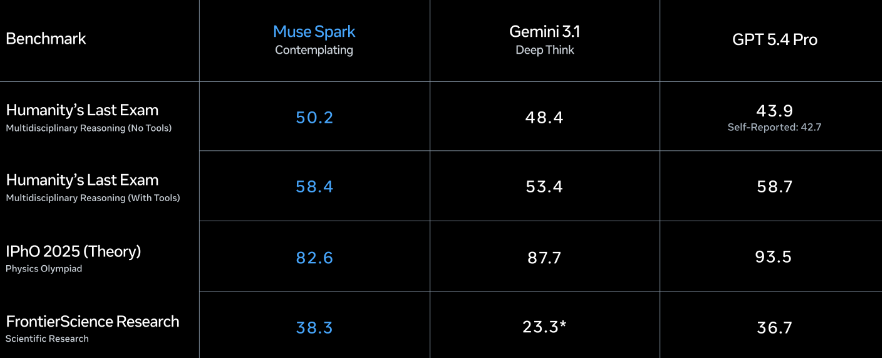
Industry observers widely believe that Muse Spark’s “deep thinking mode” is positioned to compete directly with Google’s Gemini Deep Think and OpenAI’s GPT Pro. The launch not only strengthens Meta’s position in the reasoning model space but also sends a clear signal: the AI race is shifting from a focus on sheer parameter scale to a broader competition centered on multimodal perception and advanced reasoning capabilities.
With the debut of Muse Spark, Meta is accelerating its expansion in the “superintelligence” arena, ushering global tech giants into a new phase of AI competition.