xAI Open-Sources the Complete Grok Build Codebase, Enabling Self-Compilation and Local Offline Deployment with Fully Transparent Tool-Calling Processes
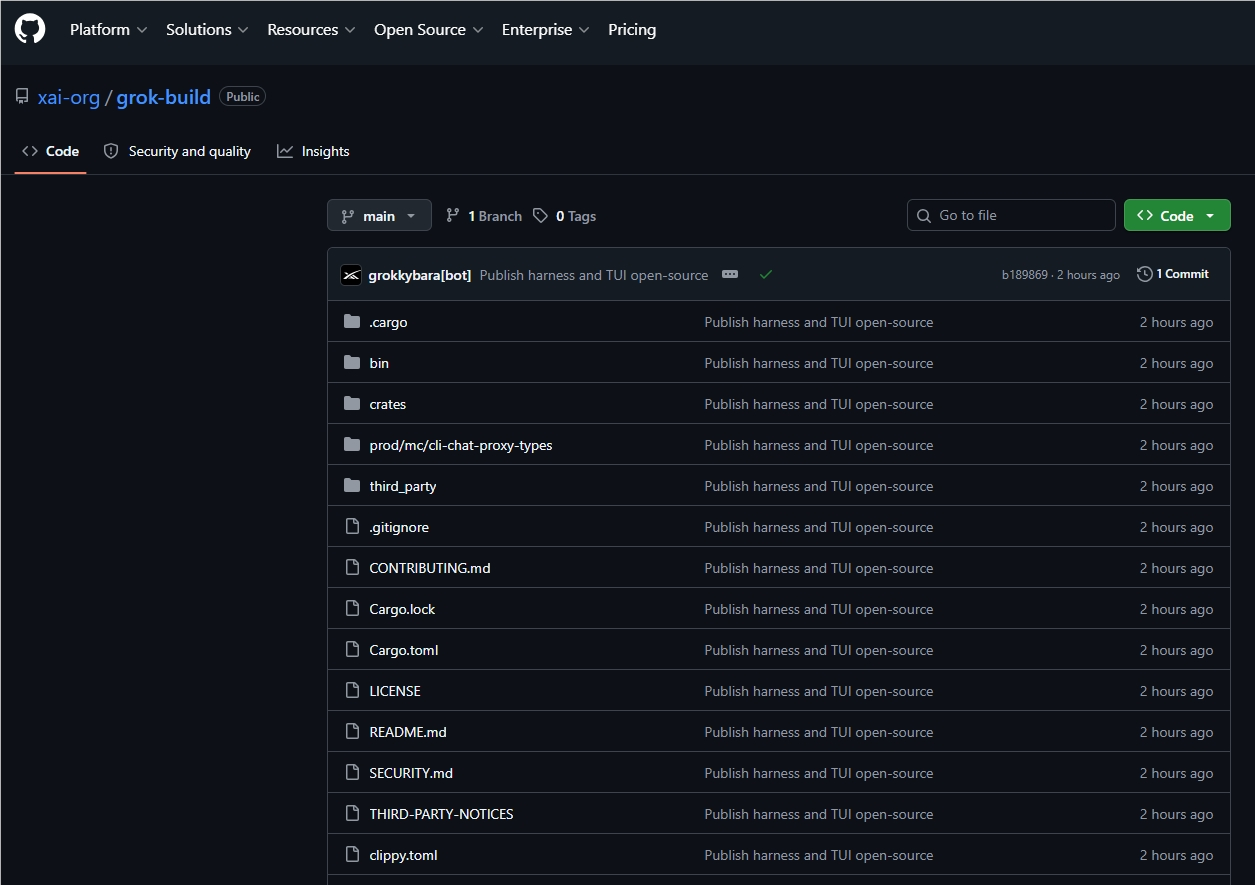
xAI has fully open-sourced its coding agent Grok Build and its terminal user interface (TUI) on GitHub, releasing the core implementations behind the agent loop, tool-calling mechanisms, terminal interactions, and extension system. Meanwhile, Grok Build supports a local-first deployment approach, allowing developers to compile the system themselves and connect it with local inference services.
xAI has publicly released the full Grok Build codebase, making the coding agent and its terminal user interface completely available on GitHub. This is not a limited sample or a partial source release. Instead, the company has opened the entire architecture, giving developers direct access to how the system actually works under the hood.
The move reflects a broader push toward transparency in AI-assisted coding tools. Rather than asking developers to rely on a closed system, xAI is now allowing them to inspect the mechanics for themselves. That includes the way Grok Build prepares context, interprets model responses, and routes tool calls for execution. In practical terms, the framework becomes something developers can verify step by step instead of simply trusting as a black box.
Transparency at the center
According to xAI, releasing the source code is the clearest path toward a stronger and more dependable execution framework. Coding agents often perform a long chain of actions behind the scenes, and when those internals are hidden, it can be difficult to understand why the system behaves a certain way. By opening Grok Build, xAI is making those internal processes visible and auditable.
That visibility matters for anyone evaluating reliability, safety, or correctness. Developers can now trace how inputs are assembled, how outputs from the model are parsed into actionable steps, and how those steps are passed into tools. The result is a system where behavior is easier to inspect, validate, and reason about.
More than source access
The release is also important from an extensibility standpoint. Open-sourcing Grok Build does more than expose the code—it provides a concrete reference for how the framework can be modified and expanded. For developers exploring custom capabilities, the codebase now serves as a practical guide rather than leaving them to infer implementation details from documentation alone.
This is especially relevant for those working with features such as skills, plugins, hooks, MCP servers, and subagents. With the implementation now visible, developers can see exactly how these parts are loaded, connected, and invoked inside the system. That makes experimentation easier and lowers the barrier to building on top of the framework.
Built for local-first use
xAI also highlighted Grok Build’s support for a fully local-first workflow. Developers can compile the project themselves from the ground up, attach it to their own local inference service, and control system behavior through the config.toml configuration file.
This setup allows the entire agent stack to run on a developer’s own machine, including offline scenarios that do not depend on cloud infrastructure. For teams and individuals who prioritize control, privacy, or self-hosted environments, that local deployment path is a notable part of the release.
What is now available
Core agent loop: the main execution flow, including context construction, model output parsing, and tool-call dispatch.
Tooling layer: implementations that show how the agent reads, edits, and searches code, while also executing commands.
Terminal interface: the TUI components for rendering, input handling, plan review, and inline diff viewing from the command line.
Extension framework: integration patterns for skills, plugins, hooks, MCP servers, and subagents.
Taken together, the release turns Grok Build into a fully inspectable and self-compilable coding agent framework. For developers interested in understanding how AI coding systems are structured—or in running one locally with transparent tool-calling behavior—the codebase is now open for direct exploration.