It’s not just one thing — it’s another thing
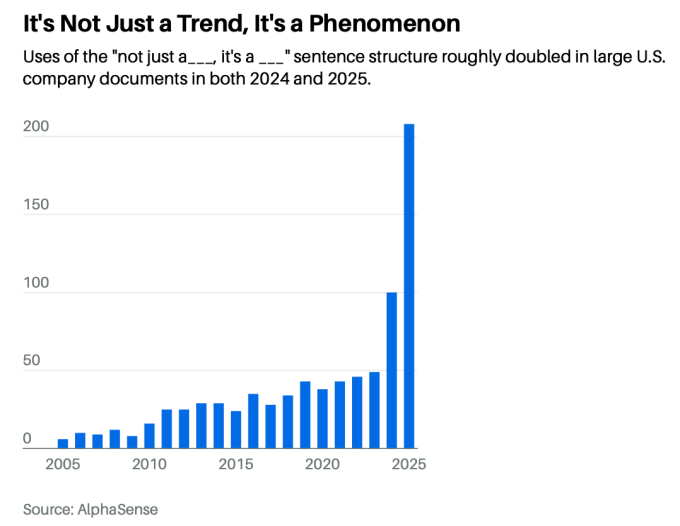
The sentence construction “It’s not just this — it’s that” has become so common in AI-generated writing that it’s now seen as a near guarantee of synthetic text. A Barron’s analysis found the phrase has more than quadrupled in corporate communications since 2023.
Sometimes, things are not just one thing — they’re also another thing. This sentence construction (“It’s not just this — it’s that”) has become so common in AI-generated writing that it’s no longer just a clue that a piece of writing may be synthetic — it’s almost a guarantee.
A Phrase on the Rise in Corporate Communications
A recent Barron’s report examined how dramatically this construction has increased in corporate communications. Rather than simply noting the trend, the publication scanned market intelligence firm AlphaSense’s database to measure how often the phrasing appeared in corporate news releases, earnings reports, and government filings.
According to Barron’s, the construction has more than quadrupled — from about 50 mentions in 2023 to over 200 uses in 2025.
Examples From the Past Year
Recent corporate statements illustrate how widespread the phrasing has become:
- “In 2025, AI won’t just be a tool; it will be a collaborator.” (Cisco)
- “The future of autonomy isn’t just on the horizon; it’s already unfolding.” (Accenture)
- “DevOps teams are managing not just deployments, but also security compliance and cloud spending.” (Workday)
- “These systems aren’t just executing tasks; they’re starting to learn, adapt, and collaborate.” (McKinsey)
- “When Bill founded Microsoft, he envisioned not just a software company, but a software factory, unconstrained by any single product or category.” (Satya Nadella in a Microsoft blog post)
- “It’s not just about building tools for specific roles or tasks. It’s about building tools that empower everyone to create their own tools.” (The same Microsoft blog post.)
- “Just imagine if all 8 billion people could summon a researcher … not just to get information but use their expertise to get things done that benefit them.” (The same Microsoft blog post.)
A Tell for AI-Generated Text?
The prevalence of this construction in generative AI outputs may reflect the writing these systems were trained on. At the same time, the repetition of the phrase in corporate messaging suggests how deeply AI tools may be influencing communications — even if it’s not possible to say for certain whether specific examples were AI-assisted.
It’s not just this sentence construction that has drawn attention; em-dashes are also increasingly viewed as a tell for AI-generated text.
What may seem like a harmless stylistic trend could be symbolic of something larger: the growing reliance on AI in corporate writing. So the next time you encounter a sentence framed as “not just this — but that,” it may be more than a catchy construction.